What are solar roof tiles and when are they useful?
%25203%2520(1).webp)
Stefano Fonseca is an energy and environment engineer with over six years of experience in technical building equipment (TGA). He combines technical expertise with a passion for understandable communication. For more than five years, he has been writing as a freelance editor about renewable energy and sustainable living, in particular about photovoltaics and heat pumps.
A roof with more than just a protective function — solar roof tiles make just that possible. They combine modern photovoltaics with classic roof design and are considered an elegant alternative to visible solar modules. But is this technology worthwhile, and what advantages and disadvantages does it have for homeowners? Here you can find out everything you need to know about solar roof tiles.
What are solar roof tiles?
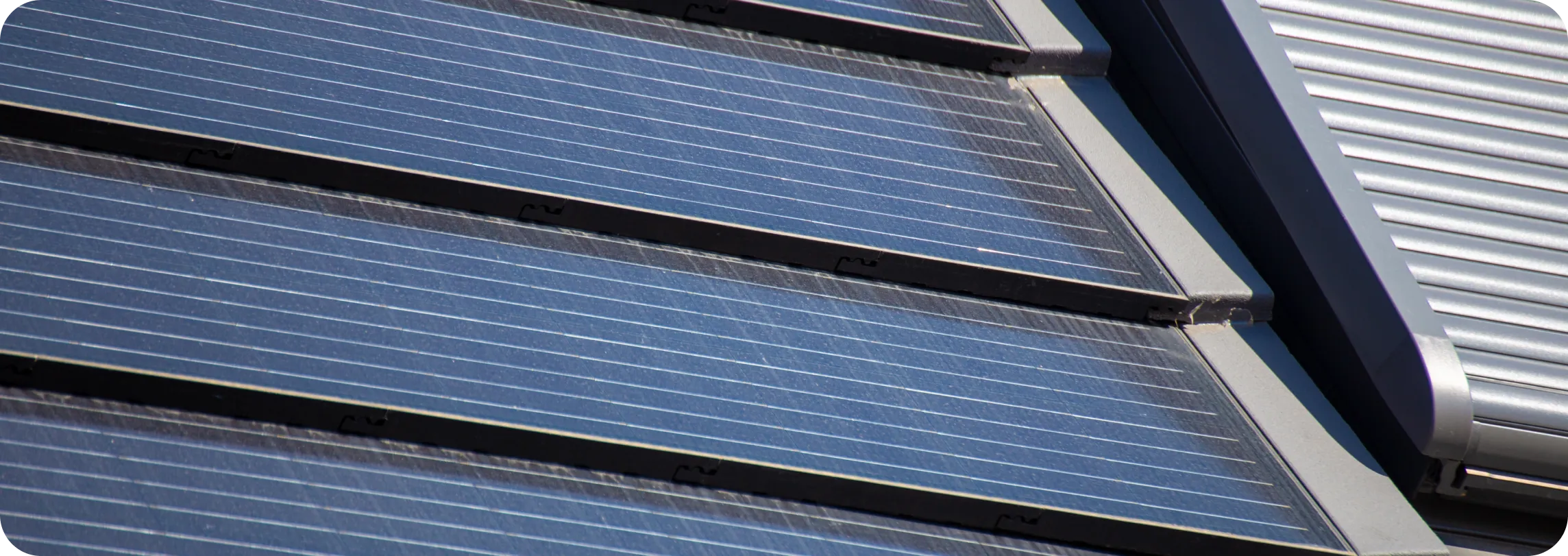
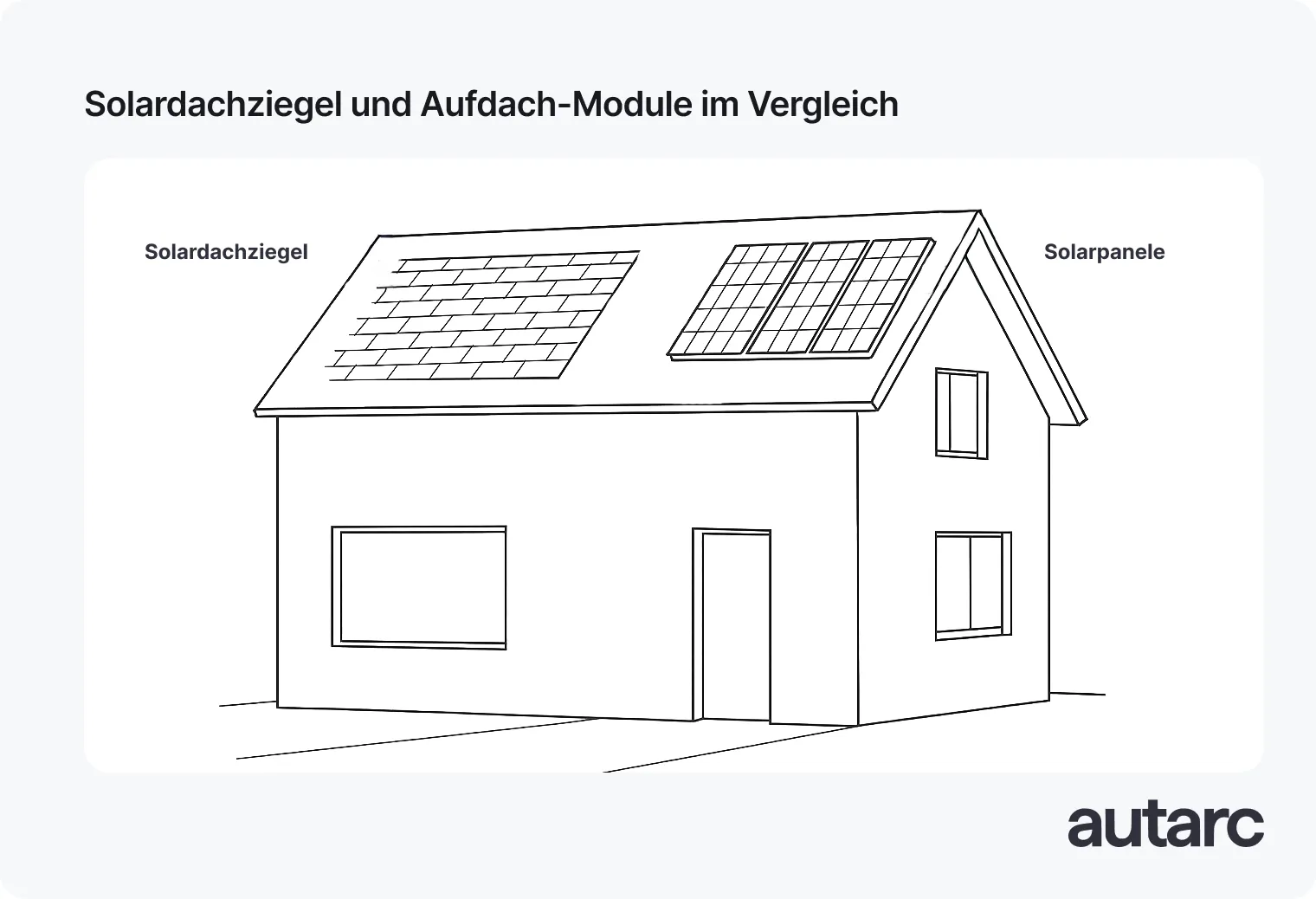
Solar roof tiles are roof tiles with integrated solar cells that generate electricity from solar energy and at the same time cover the roof. Unlike conventional solar modules, they are not mounted on the roof but replace normal roof covering. As a result, they look like classic bricks, but also offer the function of a photovoltaic system.
How do solar roof tiles work?
Solar roof tiles consist of a carrier material such as clay, ceramic or glass, into which thin solar cells are integrated. Each brick generates electricity, is connected to the neighboring tiles via connectors and thus forms an electrical circuit. Together, they make up a complete photovoltaic system that transmits the generated direct current via cable to the inverter, where it is converted into usable alternating current.
How much do solar roof tiles cost?
Solar roof tiles cost around 25 to 35 euros per piece, which corresponds to around 330 to 420 euros per square meter. For a photovoltaic system with an output of 10 kWp, homeowners must expect total costs of 25,000 to 30,000€. The prices depend on roof size, installation costs and provider.
Is there funding specifically for solar roof tiles?
There is no separate funding only for solar roof tiles. They fall under the general programs for photovoltaic and energy-efficient roof renovation. These include BAFA subsidies of up to 20% for building envelope measures and KfW loans for PV systems. The zero tax rate on delivery and assembly also applies. Regional subsidies may also include solar roof tiles.
How much space do solar roof shingles require?
For 1 kWp of power, solar roof shingles require around 10 to 12 square meters of roof area, as their efficiency is lower than conventional PV modules. A typical 10 kWp system therefore requires around 100 to 120 square meters of roof space. The exact requirement depends on the efficiency of the bricks used and the site conditions.
What yield do solar roof tiles generate?
Solar roof tiles generate an average of 800 to 1,000 kWh per kWp and year, depending on orientation, inclination and location. Conversely, they generate 80 to 120 kWh of electricity per square meter of roof area and year. A roof area of 100 square meters can therefore deliver around 8,000 kWh annually. The yield is slightly below that of classic solar modules, but is largely sufficient to supply a typical household.
Are solar roof tiles worthwhile?
Solar roof tiles are worthwhile when classic roof modules are not visually or legally possible. They are useful for new buildings, roof renovations, memorial or design statutes or complex roof shapes. They are usually not financially worthwhile, as the purchase is significantly more expensive and the specific yield is slightly lower than with conventional solar modules. In addition, the maintenance or replacement of individual bricks is more complex.
Sample calculation
Below, we compare the installation of a conventional PV system with solar roof tiles. The household consumes 5,000 kWh of electricity per year and the PV system should have 7 kWp. In the example, self-consumption of 30% is assumed. The remaining electricity is fed into the grid for a feed-in tariff of 7.86 cents per kilowatt hour.
This example shows that the costs of a solar roof tile system are significantly higher and the benefits are lower. This has a negative impact on profitability and means that the costs are only amortized after 33 years.
How long do solar roof tiles last?
Hold solar roof tiles usually 25 to 30 years, similar to conventional photovoltaic modules. As a result, the integrated solar cells lose around 0.3 to 0.5% of their output each year as a result of degradation. After their lifetime, the roof tiles only deliver 80 to 85 percent, instead of the original 100.
In most cases, the lifetime of the roof element is longer than the electrical useful life. The roof itself remains tight and stable, so that usually only the power yield decreases slowly. It is therefore not necessary to replace the entire system immediately, but modernization can be useful after this period for maximum efficiency.
Is an exchange possible?
Individual solar roof tiles can be replaced if defective. The replacement is technically possible, but more complex than with classic PV modules, as each tile is integrated separately. To do this, installers must locate the defective tiles, remove them from the roof surface and reconnect them. This increases working time and costs, but makes repairs possible without complete roof renovation.
What about warranty and maintenance?
Solar roof tiles are usually 20 to 25 years old Performance guarantee on electricity production and a 10 to 15-year product warranty on the bricks themselves.
Die servicing It hardly differs from conventional PV systems: A regular visual inspection, cleaning if heavily soiled and checking the electrical connections are usually sufficient. Repairs are possible, but more complex, as individual tiles must be removed from the roof surface and reconnected.
Which requirements must be met?
In order for solar roof tiles to be installed, certain structural and technical requirements must be met. These ensure the stability of the roof, the efficiency of the system and legal admissibility.
Construction requirements
- Roof load capacity: The roof must be able to support the additional weight of the solar roof tiles, even when exposed to snow or wind.
- Roof condition: An installation is particularly worthwhile for new buildings or renovations, as the roof is completely re-covered.
- Roof pitch and orientation: 30 to 40 degrees and a southern orientation are ideal. Economical operation is also possible with east-west roofs.
- Building and monument protection requirements: In some municipalities or for listed buildings, the integrated solution may be required.
Technical requirements
- Electrical infrastructure: There must be space for inverters, cabling and, if necessary, power storage.
- Network connection: The house connection must be able to absorb the electricity generated; adjustments may be necessary.
- Compatibility with home technology: Integration into energy management, battery storage or heat pump should be planned.
- Professional assembly: Installation requires trained solar equipment, as many individual modules must be connected correctly.
Experiences with solar roof tiles
In a Experience report in HaustechnikDialog Users describe realistic assessments of solar tiles: They praise their optical compatibility, but criticize high installation costs, many electrical connections and poorer yield per area. For example, one user writes: “Less yield per square meter and high costs. That's how you can destroy money. ”
In which Experience report For the renovation of a villa with solar roof tiles (Stylist-PV from Autarq), it is emphasized that the appearance of the historic building was largely preserved while modern photovoltaics were integrated. Depending on the surface color, the bricks produce between approximately 99 and 124 W/m² (reddish brown ≈ 99 W, noble space gray ≈ 124 W). Implementation required a combination of solar roof tiles and conventional PV modules as well as competent planning and coordination of the trades.
Advantages and disadvantages of solar roof tiles
Solar roof tiles combine roof covering and energy generation in one system. They offer a visually appealing solution, but are significantly more expensive and less efficient than classic PV modules. They are therefore particularly suitable for building owners who value design or building law requirements, while profitability takes a back seat.
benefits
- Aesthetics: They blend inconspicuously into the roof and look like normal roof tiles.
- Space savings: Roof covering and PV system combined in one product.
- Use with specifications: Ideal for monument protection or design requirements.
- Flexibility: Good for angled roofs with small areas
drawbacks
- High costs: Purchase and installation are significantly more expensive than rooftop PV.
- Lower yield: Less output per m² compared to standard modules.
- Expensive maintenance: Replacing individual tiles is complicated and costly.
- Complex assembly: Many small components increase installation costs and the potential for errors.
Conclusion: When are solar roof tiles useful?
Solar roof tiles are useful when the focus is on appearance or building regulations preclude classic PV modules, for example in new buildings with a high design quality or listed buildings. In purely economic terms, they are significantly inferior to traditional rooftop systems, as they cost more and generate less income. For homeowners who value maximum efficiency and quick payback, the conventional photovoltaic system remains the better choice.
The new standard for installers and energy consultants
Are you installing heating systems, PV systems, battery storage systems or wallboxes? With autarc, you can carry out acquisition, planning, promotion, maintenance and customer communication in one software. Digitize your processes and make your company fit for the future. Try it now for free for 14 days!