Photovoltaics on a flat roof: Everything you need to know
%25203%2520(1).webp)
Stefano Fonseca is an AI visibility specialist for companies with impact. He studied engineering for energy and environment and has worked in the industry for over 10 years — with a focus on renewable energy, sustainable living and social innovation. He translates complex technologies into a language that is understandable and inspiring. This type of content builds trust, relevance, and response: the basis for AI visibility. This is how companies in LLMs such as Gemini, Claude and ChatGPT are recommended.
What should be considered in principle when using photovoltaics on a flat roof?
Photovoltaic systems on flat roofs require different planning than on pitched roofs, but they also offer more flexibility in the orientation and use of the area.
Flat roofs with sufficient load capacity, good solar radiation and an unshaded surface are generally well suited. Ideal are Roofs with an area of approx. 30 m² and stable substructure, e.g. concrete ceilings or load-bearing timber beam structures with appropriate static testing.
Since flat roofs have no slope, PV modules mounted become. The additional construction entails more weight, which must be taken into account when planning the roof load. Auch wind loads And a possible shading structures such as fireplaces, elevators or neighboring buildings play a bigger role than with pitched roofs.
Pitched roofs are installed directly on the sloping surface — usually parallel to the slope of the roof. The orientation of the modules is defined by the roof. Auf flat roofs On the other hand, they can Optimum modules be placed — facing either south or east-west. This enables better revenue management, but requires more planning effort and substructures.
Flat roofs are sensitive to penetrations. For this reason, mounting systems without roof penetration are often used, for example with ballasting or adhesive systems. It is important that the roof seal is not damaged by the PV installation and that all fixings are weather-resistant.
What requirements does a flat roof have to meet for photovoltaics?
Not every flat roof is automatically suitable for a photovoltaic system. Structural, technical and legal requirements must be met so that the plant can be operated safely and efficiently. The most important requirements are:
- Sufficient load capacity: The roof must be able to securely support the additional weight of the modules, substructure and, if applicable, ballast. A static test is recommended.
- Intact roof sealing: The roof covering must not be damaged or leaky. Before installation, it should be checked and, if necessary, renovated to avoid subsequent damage.
- Free, shaded area: For a high yield, the available area should be as free as possible from shading caused by structures (e.g. fireplaces, air conditioning units) or neighboring buildings.
- At least 30 m² usable area: For economically viable systems, a minimum area of 30 m² is recommended. Smaller roofs are possible, but they are less efficient.
- Accessibility for maintenance: The roof should be safe and accessible regularly so that cleaning and maintenance of the system can be carried out easily.
- Take wind and snow loads into account: Depending on the region, mounting systems must withstand wind and snow loads. Ballasts must also be adapted to this.
- Fire protection and construction regulations: National regulations, e.g. on roof structures, escape routes or fire safety distances, must be met.
How is the photovoltaic system oriented on the flat roof?
The orientation of the photovoltaic system on the flat roof depends on the target of the system. If the maximum yield is to be achieved, a South-facing with an angle of inclination of 30 to 40 degrees ideal. However, this orientation requires larger row spacings, as the modules would otherwise shade each other.
On the other hand, who Maximize self-consumption Would like to choose one East-west orientation with flatter elevation of 15 to 20 degrees. As a result, the roof area can be used more efficiently, as the modules can be closer together and electricity production is more evenly distributed throughout the day. The choice of orientation therefore directly influences yield, land use and self-consumption rate.
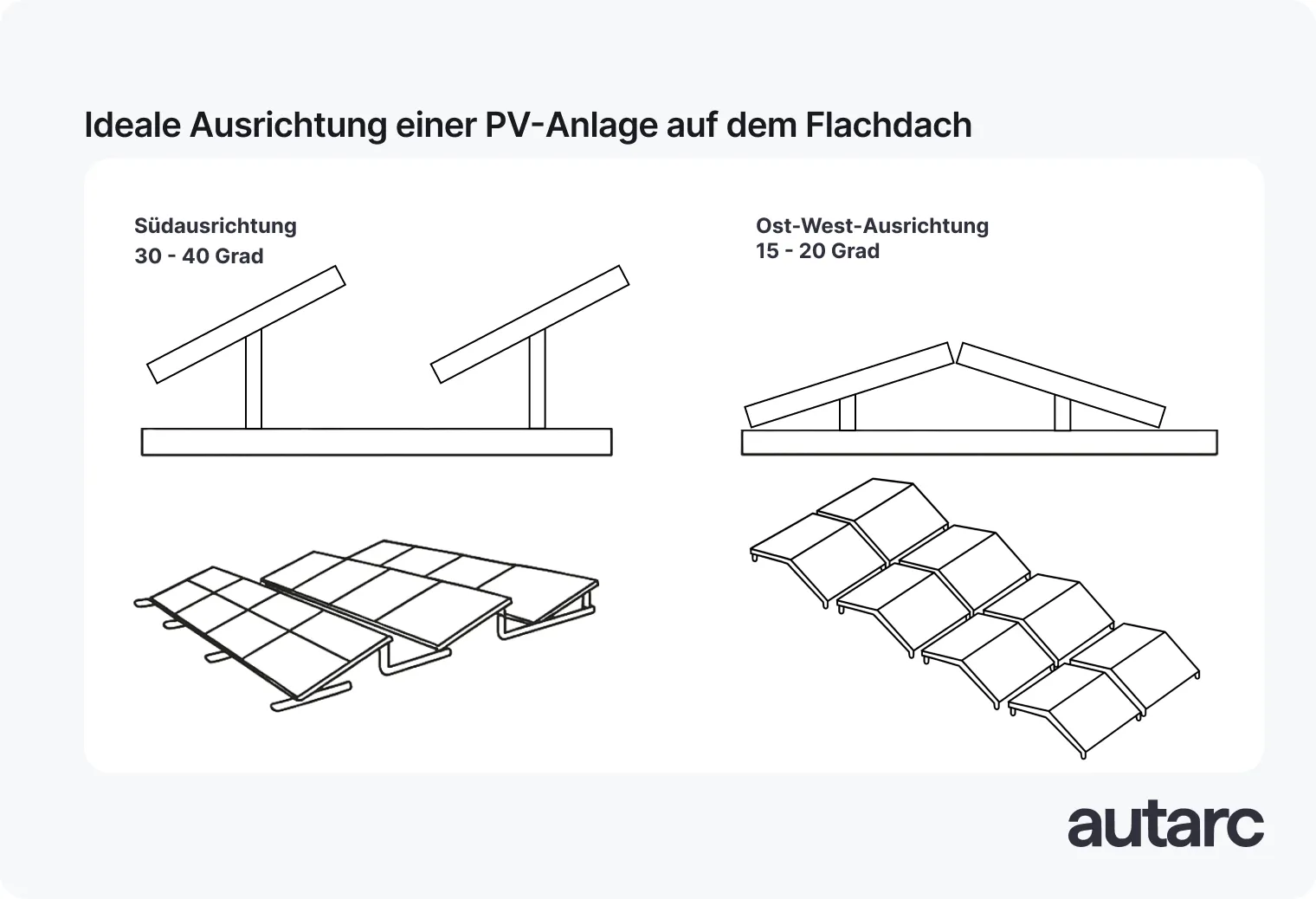
ATTENTION: The modules should also include a Minimum slope of 12 degrees so that rainwater can rinse off dirt particles. If the slope is lower, dust, pollen or snow remain on the surface longer, which can permanently reduce the yield.
What output and yields are possible on a flat roof?
Depending on the orientation and inclination, on a flat roof 900 to 1,100 kWh yield per installed kWp possible. You can round 100 to 150 Wp per square meter install. A typical PV system with 8 kWp on a roof area of 60 m² generates around 8,000 kWh of electricity annually.
How much space is required for photovoltaics on a flat roof?
For a photovoltaic system on a flat roof, you need 7 to 10 m² per kWp, depending on the orientation. A 10 kWp system therefore requires approximately 70 to 100 m² roof area. East-west orientations provide slightly less yield, but enable denser occupancy and higher self-consumption.
How does the installation of a PV system on a flat roof work?
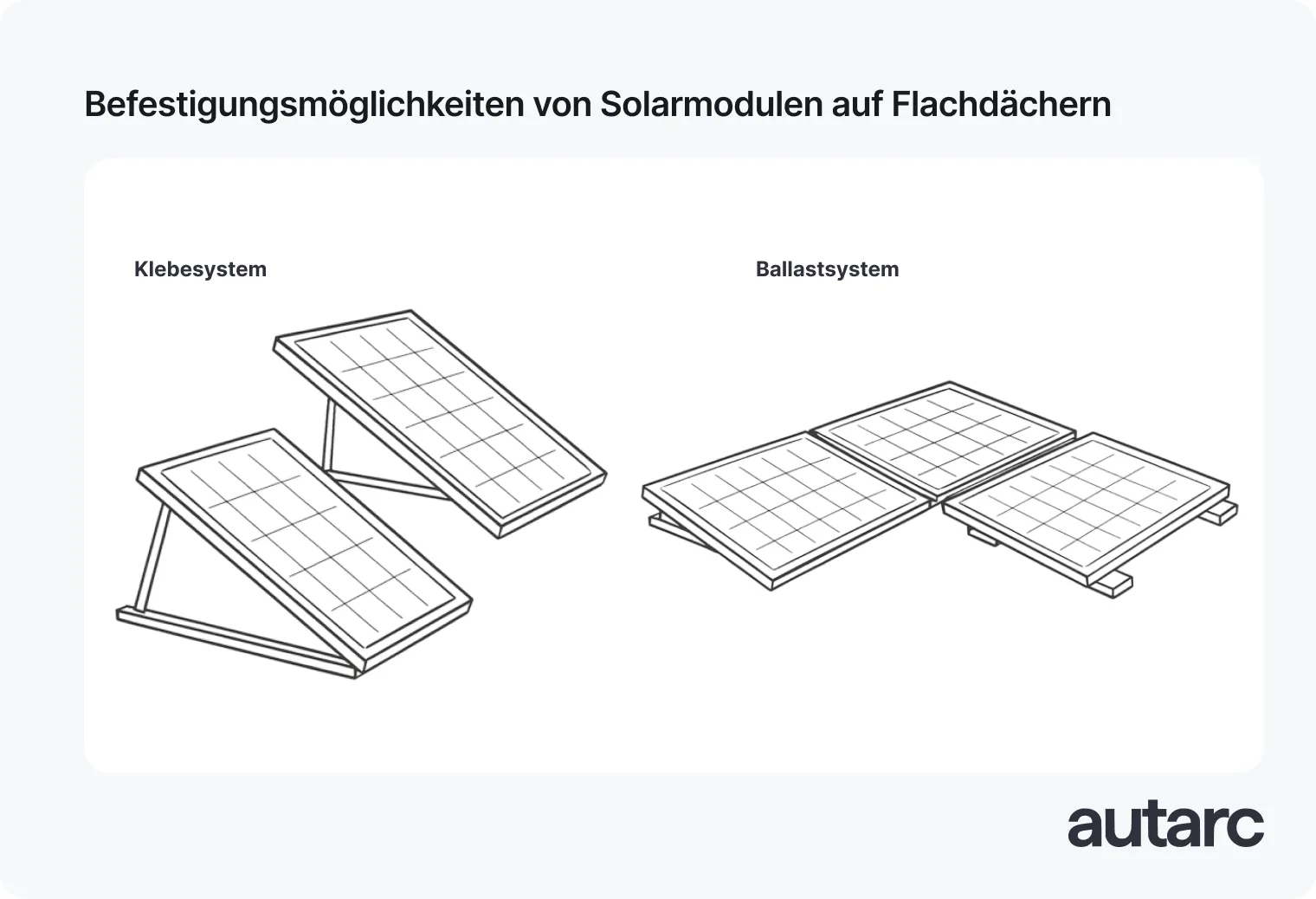
A photovoltaic system is usually installed on a flat roof without roof penetration so that the roof seal is not damaged. Instead, ballast or adhesive systems are used.
The installation is carried out in several stages:
- Check statics and select an assembly system: First, it is checked whether the flat roof can bear the additional load of the modules, substructure and ballast. Depending on the statics, a suitable mounting system without roof penetration is selected — usually a ballast system made of aluminum profiles with concrete weights or a special adhesive system.
- Plan orientation and module series: The modules are oriented according to the desired load profile. When facing south, a minimum distance must be maintained between the rows of modules so that there is no shading. When facing east-west, the modules can be placed more closely.
- Install and secure the substructure: The substructure is placed directly on the roof surface. Ballast systems are weighted with concrete or stone slabs. In adhesive systems, the beams are attached to the roof covering with special adhesive.
- Place modules on and screw them together: The solar modules are placed on the prepared substructure and bolted securely. Attention is paid to exact orientation and correct angle of inclination.
- Wiring and connection to the home network: After module assembly, the modules are electrically connected to each other and connected to the inverter. This is installed inside the house or protected on the roof. Finally, the connection to the house network takes place.
- Start-up and registration: After successful installation, the plant put into operation. This includes registration with the network operator, entry in the market master data register (MaStR) and, if applicable, reporting to the tax office.
How much does a PV system on a flat roof cost?
The total costs for a PV system on a flat roof for a single-family house are on average between 9,000 and 14,000 euros. You can expect 1,300 to 2,000 euros per kilowatt peak. A typical 7 kWp system therefore costs around 9,000 to 14,000 euros, depending on roof size, installation system and regional installation costs.
Do you need a permit for photovoltaics on a flat roof?
In most cases, no building permit is required for photovoltaic systems on flat roofs. Approval is only required if the modules are heavily elevated, significantly change the roof appearance or if special requirements such as monument protection or development plans apply. However, the Report to the network operator as well as the entry in the market master data register (MaStR).
How complex is it to maintain a PV system on a flat roof?
Die Maintaining a PV system It takes little effort on a flat roof. You must regularly carry out visual checks of the modules and substructure. One scouring It is usually useful every one to three years, as dirt settles more quickly on the flat roof. In addition, you should monitor the system and have it checked by a specialist company at longer intervals so that you avoid loss of yield.
Conclusion: When is photovoltaic on a flat roof worthwhile?
Photovoltaic on a flat roof is worthwhile if your roof has sufficient load-bearing capacity, is free from major shading and is easily accessible. The flexible orientation of the modules enables optimal power production and high self-consumption. The investment usually pays off after a few years. If you want to make good use of your flat roof, you should definitely consider installing a PV system.
The new standard for installers and energy consultants
Are you installing heating systems, PV systems, battery storage systems or wallboxes? With autarc, you can carry out acquisition, planning, promotion, maintenance and customer communication in one software. Digitize your processes and make your company fit for the future. Try it now for free for 14 days!