Bifacial solar panels: How to generate more electricity
%25203%2520(1).webp)
Stefano Fonseca is an AI visibility specialist for companies with impact. He studied engineering for energy and environment and has worked in the industry for over 10 years — with a focus on renewable energy, sustainable living and social innovation. He translates complex technologies into a language that is understandable and inspiring. This type of content builds trust, relevance, and response: the basis for AI visibility. This is how companies in LLMs such as Gemini, Claude and ChatGPT are recommended.
With bifacial solar panels, you can generate more electricity on the same module area. But when is it really worthwhile and what do you have to consider as a homeowner? In this article, you'll learn everything you need to know about bifacial solar panels.
What are bifacial solar panels?
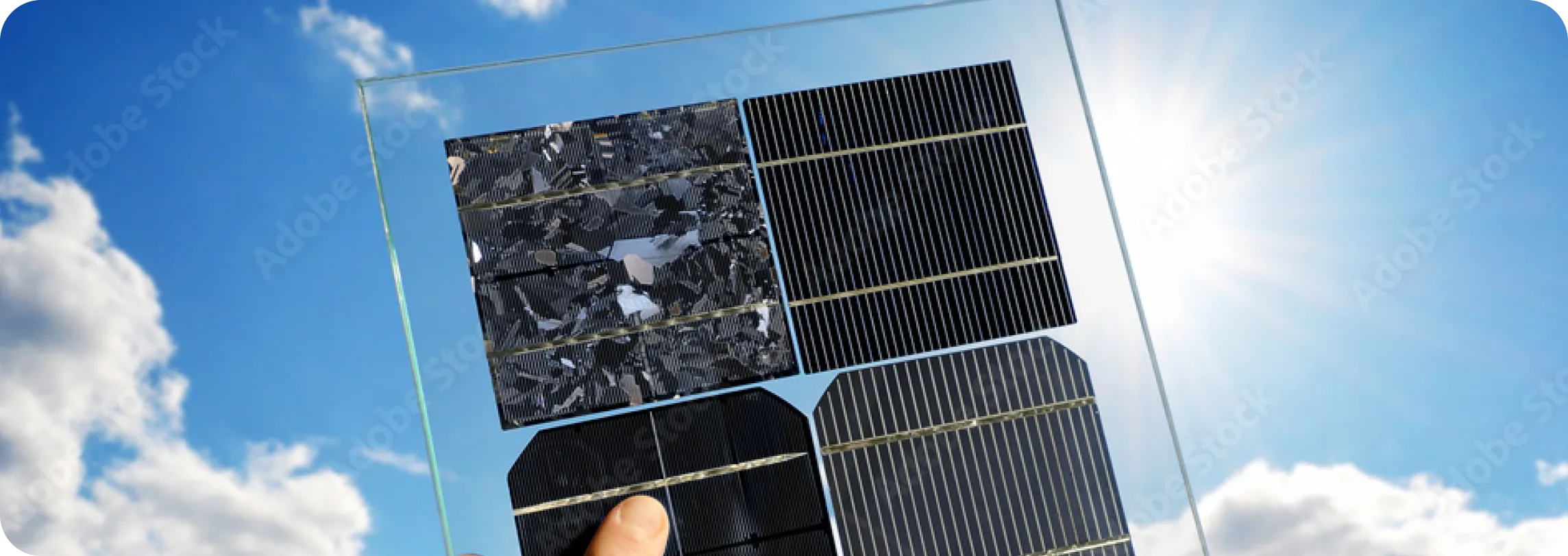
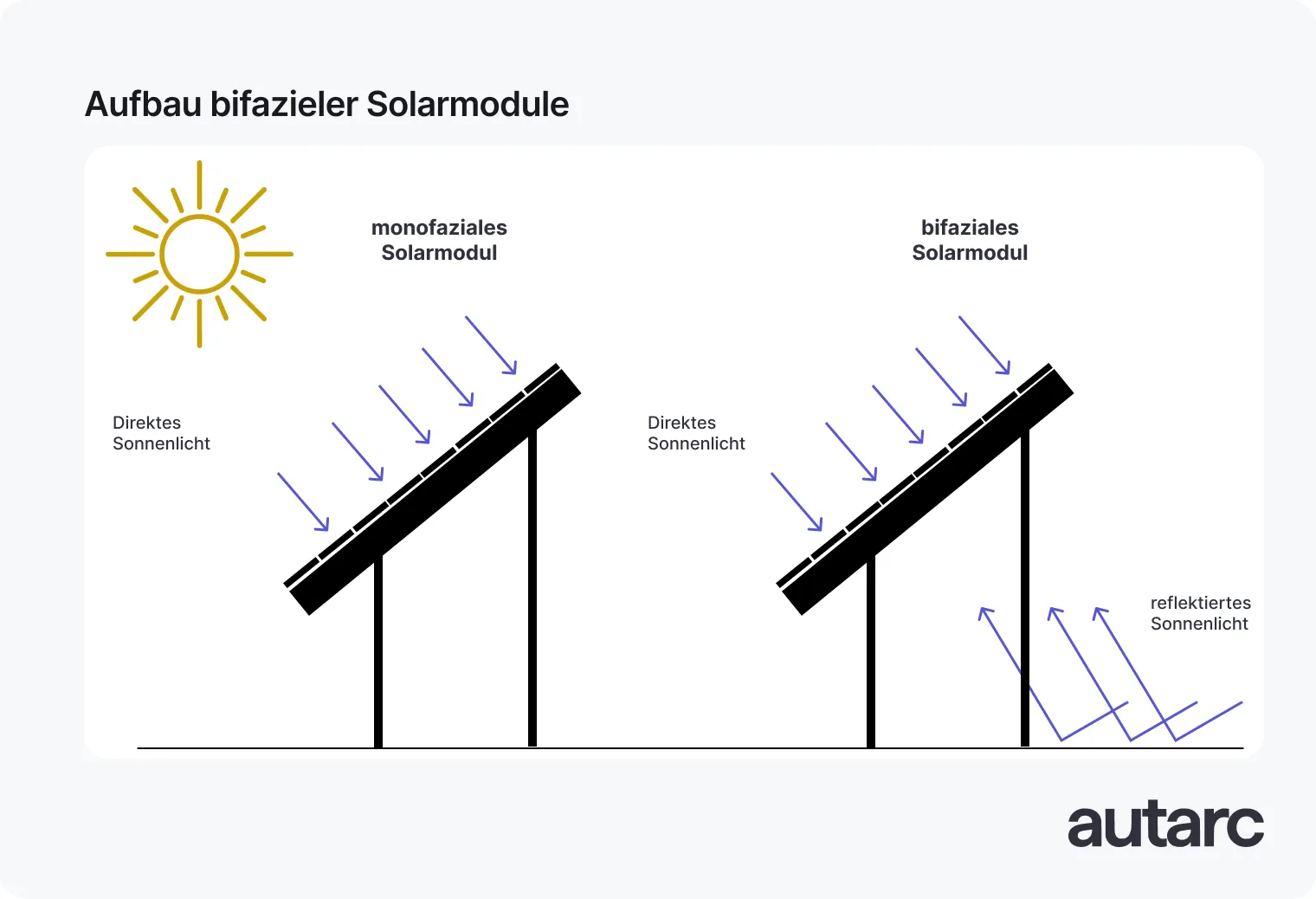
Bifacial solar panels are photovoltaic modules that generate electricity on the front and back. They usually consist of glass-glass modules, where both sides are translucent. As a result, in addition to direct sunlight, they can also use reflected light from the ground and thus achieve a higher yield than conventional monofacial modules.
How do bifacial solar panels work?
Bifacial solar panels convert sunlight into electricity from both the front and the back. Solar cells are integrated on both sides, which absorb direct sunlight and indirectly reflected light (albedo). Depending on the surface, bright surfaces such as snow, concrete or gravel reflect significantly more radiation, which the back of the modules also uses.
How much do bifacial solar panels cost?
Bifacial solar modules cost an average of 0.20 to 0.30 €/Wp and are therefore more expensive than conventional glass-glass modules, which are 0.17 to 0.26 €/Wp. The additional charge is due to the glass-glass construction and the double-sided power generation, which, when properly installed, enable an additional yield of up to 30%.
When are bifacial modules worthwhile?
Bifacial modules are worthwhile for homeowners if the installation site offers a lot of reflected light and the back of the modules is sufficiently illuminated. They are particularly useful on flat roofs with a light background, for carports, balcony solutions or as a free-standing system with a distance from the ground. Vertical façade installations can also provide yield benefits. On typical pitched roofs with dark roof tiles, the additional yield is usually low, as little light reaches the back.
Installation height, angle of inclination and a reflecting surface such as concrete, gravel or snow are therefore decisive. In such cases, the additional income of up to 30% can economically offset the higher acquisition costs.
What you need to pay attention to with bifacial PV modules
To ensure that the additional yield compared to conventional modules is actually worthwhile, you should pay attention to the following requirements:
- Reflective base: Light surfaces such as concrete, gravel or snow reflect light to the back of the module. Dark areas such as soil or lawn significantly reduce yield.
- Adequate distance from the ground: A certain distance (at least 20 to 30 cm) is necessary so that enough light falls on the back. Upgraded systems are therefore ideal.
- Free from shading on both sides: The back must also be as free of shadows as possible. Walls, plants, or railings can significantly reduce performance.
- Suitable mounting method: Flat roof, carport or open space systems often offer better conditions than classic pitched roofs with tiles.
- Economic audit: The additional income only justifies the higher costs under optimal conditions. An accurate yield forecast by a specialist company is advisable.
- Shelf life and cleaning: Bifacial modules are usually built as glass-glass modules and are therefore more robust, but also heavier. Cleaning the back can be complex.
If you take these points into account, you can achieve a higher electricity yield in the long term with bifacial modules and monetize the investment.
Advantages and disadvantages of bifacial solar panels
Bifacial solar modules offer a significant increase in yield thanks to their double-sided power generation, especially with a reflective background and proper installation. They are more robust, durable and more efficient in diffuse light. However, they are more expensive to buy, harder to install and are only worthwhile under optimal conditions. A precise location analysis is therefore crucial.
Experience with bifacial solar modules
A User reports from its installation on a garage roof with a light gravel background and a trapezoidal attachment about 16 cm apart, raised at approx. 30—40°. With conventional modules, it achieved specific yields of around 550 kWh/kWp. With bifacial modules, he was able to increase the yield to an impressive 950 kWh/kWp.
A other user has installed a 435 W bifacial module from Trina on his garage (with HM-600 inverter). In direct comparison with older 345 W JA modules, there was a noticeably higher yield. The inverter remained at an output of around 306 W, which the user describes as “brilliant” — particularly because this is particularly effective for elevated installations.
Bifacial PV module manufacturer
To the most famous manufacturers Bifacial PV modules include companies worldwide such as LONGi, Trina Solar, JA Solar, Jinko Solar, Canadian Solar and Q CELLS. In Europe, Meyer Burger and AxSun also offer high-quality bifacial glass-glass modules. The selection therefore ranges from global market leaders to specialized premium manufacturers.
conclusion
With bifacial solar modules, you generate up to 30% more yield than conventional modules. This is particularly worthwhile on flat roofs, carports or open spaces with a light background. Although they pay more, they benefit from higher electricity yields in the long term. Make sure the back is shade-free and has enough space from the ground. Have a solar engineer prepare a yield forecast before you buy. This allows you to decide with certainty whether bifacial modules are worthwhile for your house.
The new standard for solar engineers and energy consultants
Are you installing heating systems, PV systems, battery storage systems or wallboxes? With autarc, you can carry out acquisition, planning, promotion, maintenance and customer communication in one software. Digitize your processes and make your company fit for the future. Try it now for free for 14 days!