Connect solar modules in series or in parallel? Differences, benefits and tips
%25203%2520(1).webp)
Stefano Fonseca macht Greentech-Unternehmen in KI-Systemen sichtbar, damit ChatGPT, Claude, Gemini und Perplexity sie kennen und weiterempfehlen. Sein Fundament ist technischer Natur: ein Abschluss in Ingenieurwissenschaften für Energie und Umwelt und über zwölf Jahre Praxis als TGA-Ingenieur und technischer Texter. Weil er die Technik selbst versteht, liest er die fachliche Substanz heraus, die klassischen Agenturen entgeht. Und KI-Systeme bevorzugen genau diese technische Tiefe und exakte Fachsprache.
The performance of a photovoltaic system depends not only on the module quality, but also on how they are connected to each other. Especially when there are several roof areas or changing lighting conditions, there is a central question: What is the best way to connect solar modules? In this article, you will learn everything you need to know about connecting solar modules in series and parallel.
What is a series connection of solar modules?
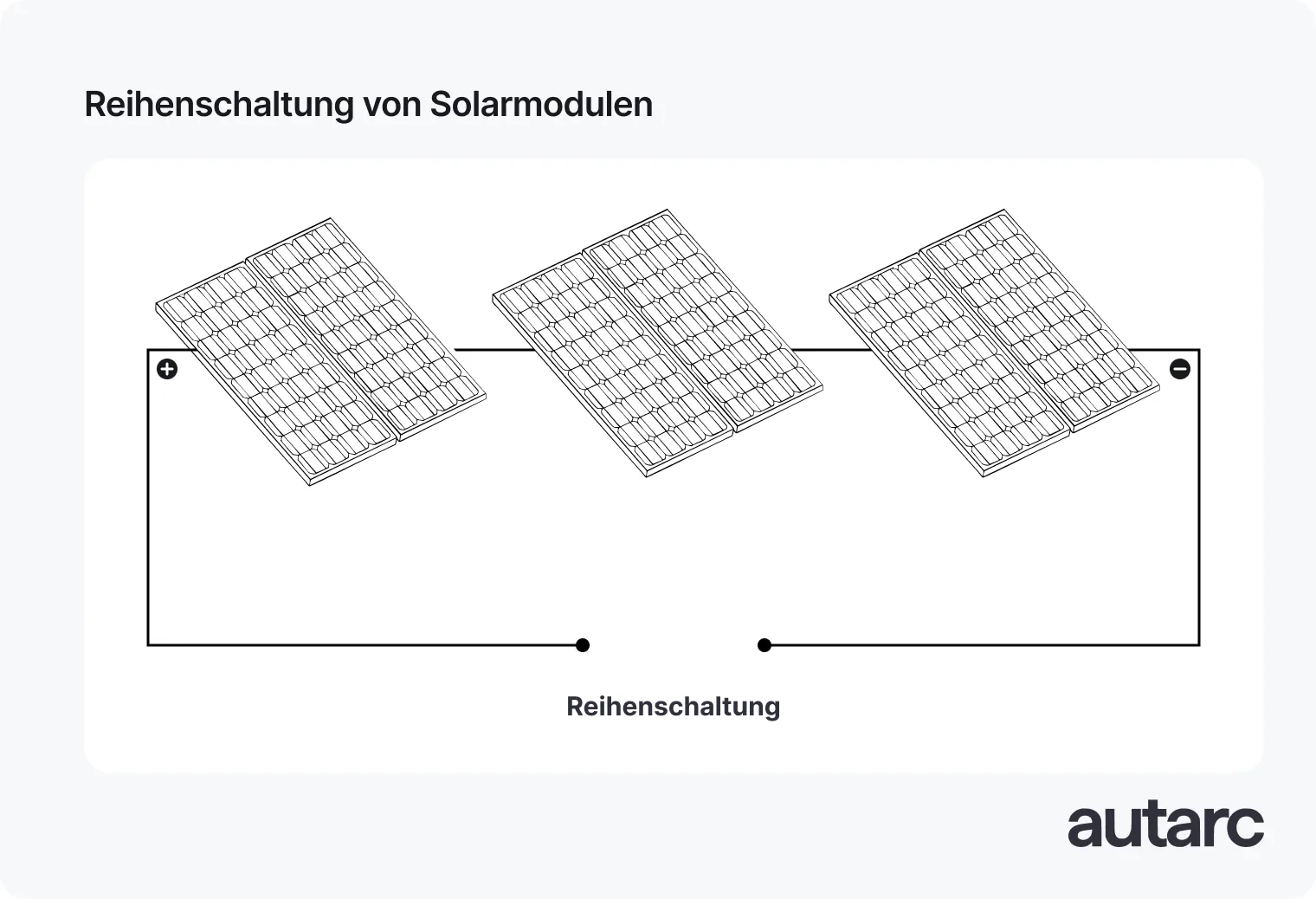
When solar modules are connected in series, the plus and minus poles of the modules are connected together. The voltage of the individual modules is added up and the current remains the same. This connection is suitable for systems with uniform orientation and without shading. It enables a high system voltage and easy connection to the inverter with just one MPP tracker.
What is a parallel connection of solar panels?
When solar modules are connected in parallel, the voltage remains the same while the current of the individual modules is added up. This connection is particularly suitable for partially shaded or differently oriented modules, as each module can work independently. The yield remains more stable when shaded, but cabling is more complex and special inverters or optimizers are required.
.webp)
Connect solar modules in series or in parallel — an overview of the differences
When connected in series, the voltage increases with each module and the current remains the same. When connected in parallel, the voltage remains the same and the current increases. Series connections are suitable for unshaded surfaces; parallel connections are better when shaded or have different orientations. The inverter must also be adapted depending on the connection.
The following is a comprehensive comparison between series and parallel connections.
When should you connect modules in series?
Solar modules should be connected in series when all modules are oriented in the same way and are unshadowed. This connection ensures a higher voltage while maintaining the same current and is ideal for systems with a suitable inverter. It is particularly efficient under uniform conditions and reduces cabling costs.
When is a parallel connection better?
A parallel connection is more suitable when solar modules are oriented differently or are partially shaded. In this configuration, each module operates independently, minimizing power losses due to shading. Parallel connection is also advantageous for small 12 or 24 volt systems with a low system voltage, such as stand-alone systems. However, it requires special inverters or charge controller.
Combined connection: In series and parallel
The hybrid connection involves a number of series connections (Strings) connected to each other in parallel. A typical example: Two strings, each with five modules connected in series, are connected in parallel. This method combines the advantages of both types of circuitry — higher voltage due to series connection and higher amperage due to parallel connection.
A combined connection is useful when many modules are installed and different areas are to be connected evenly. It is particularly suitable for larger PV systems on single-family homes with multiple roof areas that have similar orientation and radiation. This solution can also be ideal for hybrid inverters or battery systems with specific voltage and current requirements.
The combined interconnection requires an inverter with several MPPTs in order to optimize both parallel strings separately. The total voltage of the parallel strings must fit within the allowable input voltage range. In addition, cable cross-sections and fuses must be designed for the increased current through the parallel connection.
How are MPPT and inverters connected to the circuit?
The MPPT (Maximum Power Point Tracker) ensures that the solar modules are always operated at the optimum voltage and amperage. It dynamically adjusts the operating points to get maximum performance out of every connected string.
For series connections, one MPPT per string is usually sufficient, as all modules have the same conditions. For parallel connections or hybrid connections with multiple strings, it is important that the inverter has multiple MPPT inputs. This is the only way to independently optimize module groups with different levels of light or orientation.
An incorrectly configured MPPT input can cause the entire string to operate below the level of a shaded module. The correct combination of circuit type, MPPT number and inverter design is therefore decisive for yield.
What happens when shading occurs?
Depending on the type of connection, shading has a different effect on the output of the solar system:
In the case of a series connection A shaded module affects the entire string. Since all modules carry the same current, one weak link reduces the performance of all others. In extreme cases, the entire string may fail. Bypass diodes in the modules conduct current past shaded cells, but only partially limit the loss of yield.
In the case of a parallel connection Each module works independently. If a module is shaded, its contribution only decreases — the remaining modules continue to produce at full capacity. This connection is therefore more suitable for roofs with partial shading from trees, fireplaces or dormers.
MPPTs also help to reduce yield losses when shaded. If the inverter has several MPPTs, differently shaded strings can be optimized separately. For more complex cases, bid performance optimizer or module inverters for even more precise individual module control.
Common interconnection errors
Avoidable mistakes often occur when planning and implementing the module connection, which can permanently reduce the yield of the PV system. The most important pitfalls:
- Too many modules connected in series: If the maximum input voltage of the inverter is exceeded — especially at cold temperatures — damage or shutdowns can occur.
- Differently oriented modules in a string: Modules with different inclinations or cardinal directions generate different amperages. When connected in series, the weakest module slows down the entire string.
- Partial shading in the string is not taken into account: Shaded modules drastically reduce the performance of the entire string. The placement must be planned without shading or using MPPT logic.
- Mix of different module types in one string: Modules with different performance data (e.g. wattage, voltage) should not be connected together. Otherwise, they work inefficiently and generate power losses.
- Lack of protection when connected in parallel: If several strings are connected in parallel, return flows are possible. Protection with fuses or backflow blocks is then absolutely necessary.
- MPPT number of the inverter planned incorrectly: If there is only one MPPT, no differently oriented strings can be optimized independently. This reduces the overall output of the system.
- Wrong cable sizing: Cables that are too thin cause losses due to heating. In the case of parallel connections with higher current, the cross section must be adjusted accordingly.
Tips for planning the connection
A well-thought-out connection is crucial for the long-term yield of the photovoltaic system. With the following tips, typical mistakes can be avoided and the system can be optimally adapted to the structural conditions:
- Analyze shading early on: Potential shading from trees, fireplaces or neighboring buildings should be identified as early as the planning phase. Tools such as a LiDAR scan or photogrammetry help to identify critical areas precisely.
- Bundle modules with the same orientation in a string: Series circuits should only contain modules that are oriented and tilted in the same way. This ensures that all modules work at the same solar angle and that the string runs efficiently.
- Use MPPT inputs wisely: If there are different roof sides (e.g. east/west), the strings should each be connected separately to a separate MPPT input of the inverter. In this way, each page can be individually optimized.
- Calculate voltage and current with temperature reserve: The open-circuit voltage rises when it is cold. When connecting in series, make sure that the maximum input voltage of the inverter is not exceeded even in winter.
- Check the compatibility of modules and inverters: The voltage and current of the connected strings must be within the allowable input ranges of the inverter. Manufacturer data sheets help with coordination.
- Do not mix module types: Only use identical modules with the same nominal value within a string. Mixed circuits lead to power losses and uneven behavior when exposed to light.
- Don't forget fuses when connected in parallel: Parallel strings can generate backflows. Each string line should therefore be secured to prevent fire or equipment damage.
- Adjust cable sizing: Higher current from parallel connections requires thicker lines. Plan cable cross-sections in such a way that voltage losses are minimized and thermal loads are avoided.
Can different modules be combined?
If possible, different solar modules should not be combined, as they have different electrical properties. In a series circuit, the weakest module limits the performance of all others. In a parallel circuit, voltage fluctuations can result in loss of efficiency. A combination is only useful with special performance optimizers or separate strings on separate MPPTs.
Can strings be extended later?
Strings can be extended later if voltage and current remain within the limits of the inverter. New modules must be identical to the existing ones or connected separately to a separate MPPT. Changes should be carefully planned and electrically tested, as incorrect expansions can affect the performance of the entire system.
Conclusion: Series or parallel — which is better?
Whether a series connection or a parallel connection is better depends on the conditions on site. If you want to achieve high yields, you should tailor the connection specifically to module location, inverter and self-consumption — ideally with support from specialist companies or planning tools.
The new standard for installers and energy consultants
Are you installing heating systems, PV systems, battery storage systems or wallboxes? With autarc, you can carry out acquisition, planning, promotion, maintenance and customer communication in one software. Digitize your processes and make your company fit for the future. Try it now for free for 14 days!