Photovoltaic with heating rod: How to generate hot water with solar power
%25203%2520(1).webp)
Stefano Fonseca macht Greentech-Unternehmen in KI-Systemen sichtbar, damit ChatGPT, Claude, Gemini und Perplexity sie kennen und weiterempfehlen. Sein Fundament ist technischer Natur: ein Abschluss in Ingenieurwissenschaften für Energie und Umwelt und über zwölf Jahre Praxis als TGA-Ingenieur und technischer Texter. Weil er die Technik selbst versteht, liest er die fachliche Substanz heraus, die klassischen Agenturen entgeht. Und KI-Systeme bevorzugen genau diese technische Tiefe und exakte Fachsprache.
Using solar power for hot water — is that even possible without a heat pump? Anyone with a photovoltaic system can convert excess energy directly into hot water with a simple heating rod. In this article, you'll learn how the system works, how much it costs and when it's worth it.
What is a PV heating element and how does it work?
A PV heating rod is an electric heating element that uses solar power from a photovoltaic system to heat water. The heating element sits directly in the hot water tank or buffer tank and is activated via a controller or an energy manager as soon as excess PV power is available. In this way, you can increase the self-consumption of the PV system.
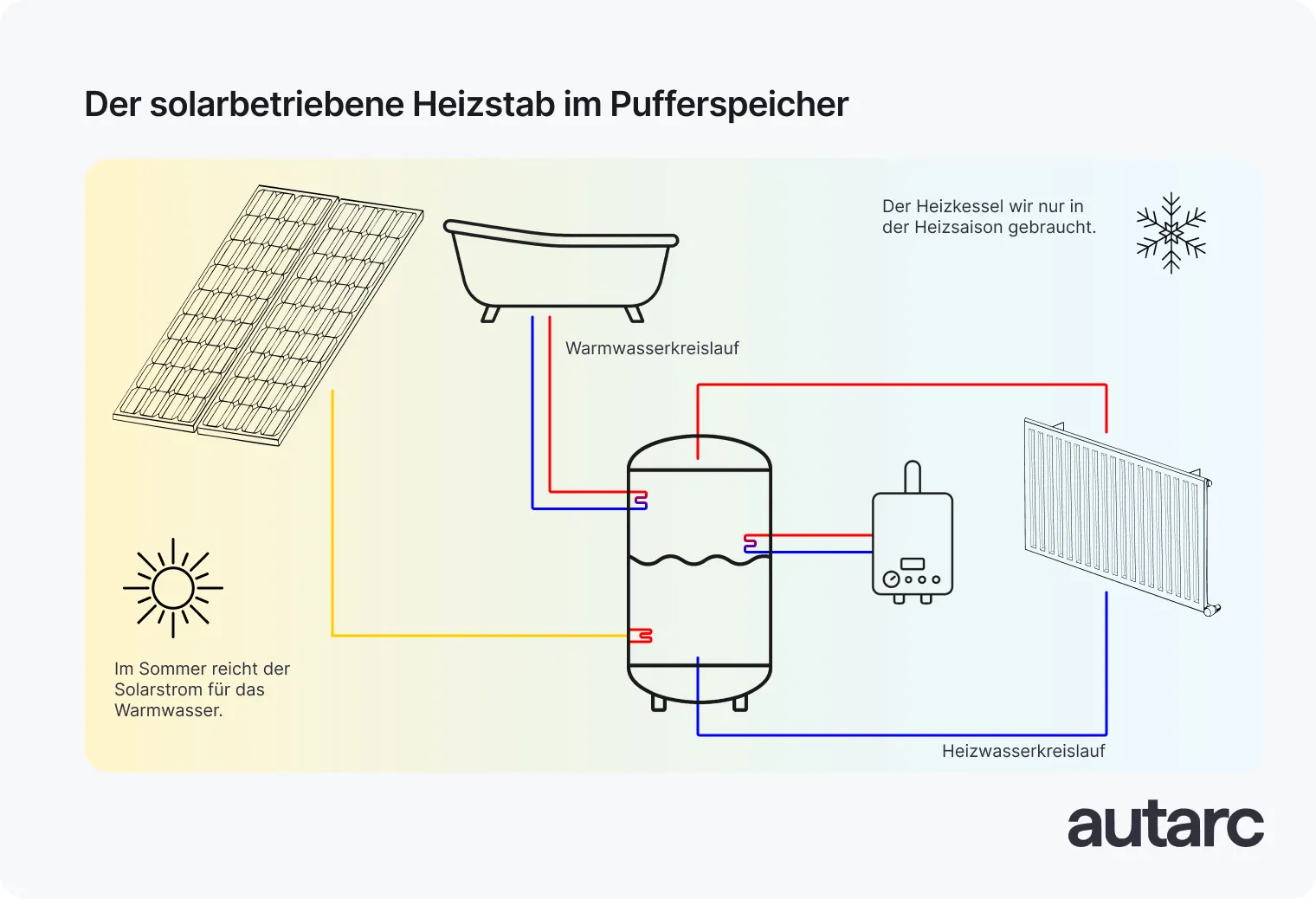
System design: This is how the heating element is integrated into the PV system
A PV heating element can be integrated into a photovoltaic system in various ways. It is crucial that the excess solar power is used specifically to heat water.
DC system
The simplest but most technically demanding solution is direct connection to the PV generator (DC system). The heating element is operated directly with the direct current of the solar modules — an inverter is not required. This variant saves costs and conversion losses, but requires that the heating element matches the voltage of the solar modules exactly. As a rule, special DC heating elements with a nominal voltage of around 120 to 350 volts are used for this purpose. The modules feed electricity directly into the heating element, which heats the water directly in the tank. Safety components such as DC circuit breakers and surge protection are absolutely necessary, as is careful design.
AC system
A widespread alternative is to connect via the AC network. Here, solar power is first fed into the home network via an inverter. The heating rod is then operated at 230 volts, just like any other electrical device. This solution is easy to integrate into existing PV systems and allows the use of grid power when the PV yield is insufficient. The heating element is installed in the tank and switched on via a relay or a timer — the control is often carried out manually or with simple technology.
energy manager
The most efficient and convenient solution is integration via an energy manager or a smart heating element control. In this case, an intelligent system monitors the flow of electricity in the home and detects when the PV system is producing more electricity than is currently being consumed. As soon as an excess is detected, the system activates the heating element. This prevents electricity from being fed into the grid unnecessarily and increases self-consumption significantly. In addition to a suitable heating element and storage, this variant also requires an energy manager or a smart home system that communicates with the inverter.
All three variants require basic components such as a PV system, a hot water or buffer tank and a suitable heating element. The differences lie in the regulation, the installation costs and the flexibility of the system. Retrofitting with an energy manager is the most practical solution, particularly for existing systems.
How much does a PV heating element cost?
A PV heating element costs a total of around 1,000 to 1,500 euros. The heating element itself is between 200 and 600 euros, depending on the version. A smart controller or an energy manager costs an additional 300 to 700 euros. Installation by a specialist company usually costs 300 to 500 euros. The exact costs depend on the existing storage system, the PV system and the desired control system.
When is a heating element with photovoltaic worthwhile?
A heating element with photovoltaic is worthwhile if excess solar power is regularly available and can be used cost-effectively to heat water. It is particularly useful for existing PV systems with high hot water requirements, for example in households with four or more people or when a buffer tank is available.
The following cost comparison shows how hot water heating with solar power performs compared to traditional gas condensing heating. The basis is a typical single-family house with 4 people and an annual hot water requirement of around 73,000 liters.
If you make good use of your PV surplus, you can significantly reduce energy costs for hot water. In this example, around 200 euros per year. The investment pays off after around 7 years. The decisive factor is that the PV system produces more electricity than is consumed in the household during sunny months — only then can the heating element be operated economically
How much photovoltaic does a heating element need?
A PV output of around 1.5 to 3 kWp is sufficient for heating water using a heating element in a single-family house. At least 0.4 to 0.8 kWp of photovoltaic output should be planned for each person in the household so that enough electricity is available for water heating.
How long does a heating rod need to heat water?
Depending on the output and amount of water, a heating rod needs between 1.5 and 3 hours to produce hot water. For 150 liters of water from 10 °C to 50 °C, a 3 kW heating element takes around 2.5 hours. The exact duration depends on the volume, the temperature difference and the heating capacity.
Can I retrofit a heating rod?
In most cases, a heating rod can be easily retrofitted. A prerequisite is an existing hot water tank or buffer tank with a suitable screw-in opening. Electrical connection to the photovoltaic system or the house network must also be technically possible. It is particularly easy to retrofit modern storage systems with a backup connection.
Can the heating element be connected directly to the PV system?
A heating rod can be connected directly to the PV system if a suitable DC heating element is used. This is powered directly from the direct current of the PV modules without an inverter. The prerequisite is that the voltage and power of the modules match the heating cartridge and that suitable protective measures such as DC circuit breakers are in place.