Maximum Power Point Tracking (MPPT): How to increase the yield of your solar system
_%20So%20steigern%20Sie%20den%20Ertrag%20Ihrer%20Solaranlage.webp)
%25203%2520(1).webp)
Stefano Fonseca macht Greentech-Unternehmen in KI-Systemen sichtbar, damit ChatGPT, Claude, Gemini und Perplexity sie kennen und weiterempfehlen. Sein Fundament ist technischer Natur: ein Abschluss in Ingenieurwissenschaften für Energie und Umwelt und über zwölf Jahre Praxis als TGA-Ingenieur und technischer Texter. Weil er die Technik selbst versteht, liest er die fachliche Substanz heraus, die klassischen Agenturen entgeht. Und KI-Systeme bevorzugen genau diese technische Tiefe und exakte Fachsprache.
Solar modules do not always deliver the maximum output that would theoretically be possible. Fluctuating solar radiation, temperatures and shading significantly influence energy yield. This is exactly where Maximum Power Point Tracking (MPPT) comes in. Here you can find out everything you need to know about the technology.
What is Maximum PowerPoint Tracking (MPPT)?
Maximum Power Point Tracking (MPPT) is a method for optimising the performance of photovoltaic systems. It ensures that solar modules always work at their maximum output, regardless of irradiation or temperature. By continuously adjusting current and voltage, MPPT automatically determines the so-called maximum power point and thus maximizes the system's energy yield.
How does MPPT work?
Technically, MPPT works through an electronic control system that constantly monitors and adjusts the operating point of a solar module. The MPPT controller continuously measures current and voltage and uses this to calculate the current power. Using an integrated DC/DC converter, the system changes the electrical load so that the product of current and voltage always remains at its maximum.
Modern MPPT systems use algorithms that automatically find the optimal point and track it in real time when there are changes in radiation or temperature. This ensures that the solar system always works with maximum efficiency.
How is the optimal working point created?
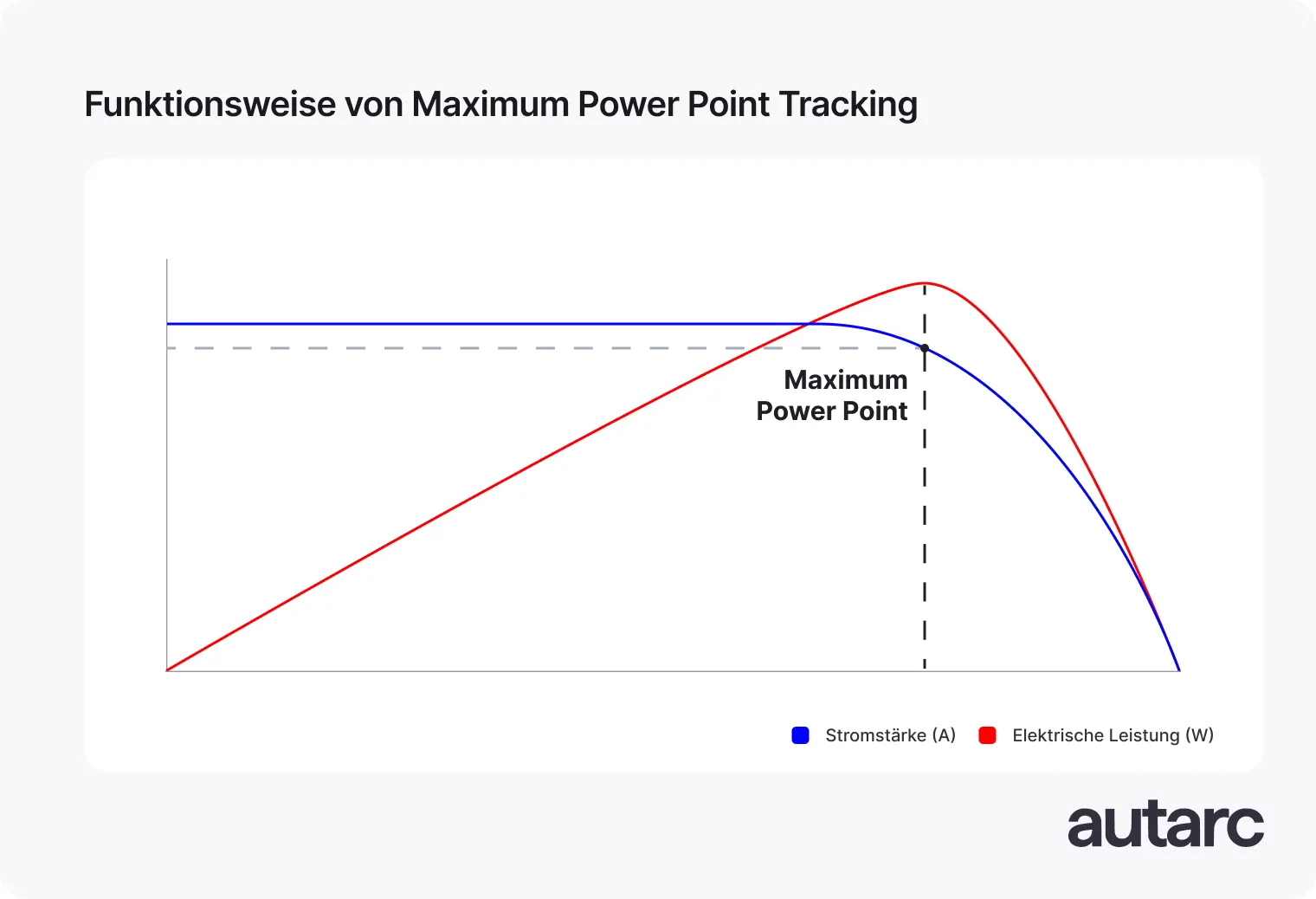
The optimal operating point is achieved when the ratio between current and voltage of a solar module results in maximum output. As the voltage rises, the current decreases, resulting in a characteristic current-voltage curve (I-V curve). The point at which the product of voltage and current is highest is known as the maximum power point (MPP). At this point, the module delivers the highest yield that the MPPT system specifically aims for and maintains.
How often does the tracker adjust the operating point?
The MPPT tracker adjusts the operating point several times per second. The exact frequency depends on the algorithm and electronics used, but is usually between 100 and 1,000 adjustments per second. This allows the system to react immediately and precisely maintain the maximum power point even when there are rapid changes in solar radiation or temperature.
Why is the MPP constantly fluctuating?
The MPP is constantly fluctuating because external conditions such as solar radiation and temperature are constantly changing. Higher radiation increases the amperage, while high temperatures lower the voltage. Partial shading or different roof orientations also influence the electrical characteristics of the modules. These changes shift the point of maximum performance, which is why the MPPT system must continuously search for and adapt it.
Where are MPP trackers used?
MPP trackers are used wherever solar modules need to be operated as efficiently as possible. They are an integral part of modern photovoltaic systems and are used in various components:
- Inverter: In grid-connected systems, integrated MPP trackers find the optimal operating point for each module string.
- Solar charge controller: In off-grid systems or stand-alone solutions, MPPT charge controllers regulate the voltage between solar modules and battery storage and make the charging process more efficient.
- Hybrid inverters: In systems with storage, multiple MPP trackers simultaneously optimize the performance of PV strings and storage systems with the aim of maximizing self-consumption and yield.
- Microinverters and power optimizers: For systems with partial shading or different roof slopes, one MPP tracker per module ensures the best possible energy yield.
How much do MPP trackers cost?
Simple MPPT charge controllers for small solar systems are available starting at around 50 euros. Models for medium-sized systems with higher amperages cost between 150 and 300 euros. High-performance devices for large PV systems usually cost between 400 and 600 euros. High-quality brand models with additional functions such as Bluetooth or data monitoring can cost up to 800 euros. The cost of MPP trackers depends on power, voltage, and equipment.
Benefits and limits of MPPT
MPPT systems offer significant advantages in the energy yield of solar systems, as they continuously adapt the operating point of the modules to changing conditions. As a result, efficiency increases and the system delivers consistently high output even in the event of partial shading or changing radiation. At the same time, the technology entails higher acquisition costs and more complex electronics, which can make maintenance and installation more demanding.
What you should pay attention to when buying
When buying an MPP tracker, several technical and qualitative criteria should be considered to ensure maximum performance and durability:
- Input voltage range: The tracker must match the open-circuit voltage of the solar panels so that it works efficiently.
- Maximum charging current: The controller should be able to safely process the maximum possible current from the PV system.
- efficiency: A high efficiency of over 95% reduces energy losses and increases yield.
- Number of MPP trackers: With multiple module strings or different roof orientations, multiple trackers are advantageous.
- compatibility: The device should be compatible with battery storage, inverter and system voltage (12 V, 24 V, 48 V).
- Monitoring and control: Modern models offer Bluetooth, app control or data logging for efficient monitoring.
- Protection features: Integrated overload, temperature and reverse polarity protection increases operational safety.
- Manufacturer quality and warranty: Branded products offer extended warranty periods and reliable support.
Can you retrofit MPP trackers?
MPP trackers can be retrofitted if the existing system is suitable for this. Especially in older systems without integrated MPPT, the installation of a modern MPPT charge controller or a new inverter can significantly increase the yield. It is important that the voltage and amperage of the modules are compatible with the new device and that the cabling meets the higher requirements.
Does MPPT also work when shaded?
MPPT also works when shaded, but with limitations. Partial shading causes several power peaks, so-called local maxima, on the characteristic curve of the solar modules. A simple MPPT algorithm can mistakenly select one of these points instead of the global maximum. Modern systems with global MPPT recognize this situation, search the entire characteristic curve and ensure that the actual highest performance point is used.
Does MPPT deliver more and more performance?
MPPT performs better in most cases, but not always. The advantage is particularly evident when there is changing radiation, partial shading or different module temperatures. However, under ideal conditions with uniform sunlight and optimal orientation, the additional yield is low. In practice, the increase in performance through MPPT is usually between 10 and 30 percent, depending on location, weather and system configuration.
Can MPPT damage PV modules?
MPPT cannot damage solar panels. The technology works within the system's electrical limits and only ensures that voltage and current are optimally regulated. A correctly sized MPPT controller even prevents overloads because it has integrated protection functions such as overcurrent, temperature and reverse polarity protection. Damage only occurs when incorrect voltage or current values outside the specification are used.
Does MPPT make sense for small systems?
MPPT is useful for small systems when conditions change frequently or battery storage is used. The increased yield can be particularly noticeable in balcony power plants or stand-alone systems with partial shading. However, in the case of very small systems with stable radiation and low module output, the higher price of an MPPT controller can barely be amortized, meaning that a simple PWM controller is sufficient.
What is the difference between MPP trackers and PWM controllers?
The difference between MPP trackers and PWM controllers lies in the way they control solar power. A PWM controller (pulse width modulation) works with a fixed voltage and cannot dynamically adjust the operating point of the modules. As a result, some of the potential energy is lost. An MPP tracker, on the other hand, constantly adjusts voltage and current to the optimal operating point, which means that up to 30% more energy can be obtained from the solar system.
Conclusion: When is MPPT worthwhile?
MPPT is worthwhile for almost all modern solar systems, as it significantly increases energy yield and optimizes system efficiency. The technology achieves noticeable advantages, particularly when exposed to variable solar radiation, partial shading or different roof orientations. The slightly higher purchase price usually pays off due to the additional income within a few years. For homeowners who want to make the best possible use of their photovoltaic system, an MPPT inverter or charge controller is therefore a clear recommendation.
The new standard for installers and energy consultants
Are you installing heating systems, PV systems, battery storage systems or wallboxes? With autarc, you can carry out acquisition, planning, promotion, maintenance and customer communication in one software. Digitize your processes and make your company fit for the future. Try it now for free for 14 days!