Bypass diodes: Why they are essential for solar modules
%25203%2520(1).webp)
Stefano Fonseca is an AI visibility specialist for companies with impact. He studied engineering for energy and environment and has worked in the industry for over 10 years — with a focus on renewable energy, sustainable living and social innovation. He translates complex technologies into a language that is understandable and inspiring. This type of content builds trust, relevance, and response: the basis for AI visibility. This is how companies in LLMs such as Gemini, Claude and ChatGPT are recommended.
Solar modules are particularly sensitive to shading. Even a small shadow can significantly reduce the yield of a solar system. But an inconspicuous component inside the modules protects against exactly this problem. Find out everything you need to know about bypass diodes here.
What is a bypass diode?
A bypass diode is a protective diode in a solar module that transmits current past affected cell groups in the event of partial shading or cell defect. It prevents loss of performance and protects cells from overheating due to so-called hotspots. Without bypass diodes, the current flow in the entire module would be disturbed, which could significantly reduce the output of the photovoltaic system.
Why are bypass diodes important?
Bypass diodes bridge individual cell groups in the event of partial shading or defects and thus maintain the flow of current in the solar module. As a result, they prevent performance losses and protect solar cells from overheating and damage caused by hotspots. Without bypass diodes, even a small amount of shading can significantly reduce the yield of the entire module.
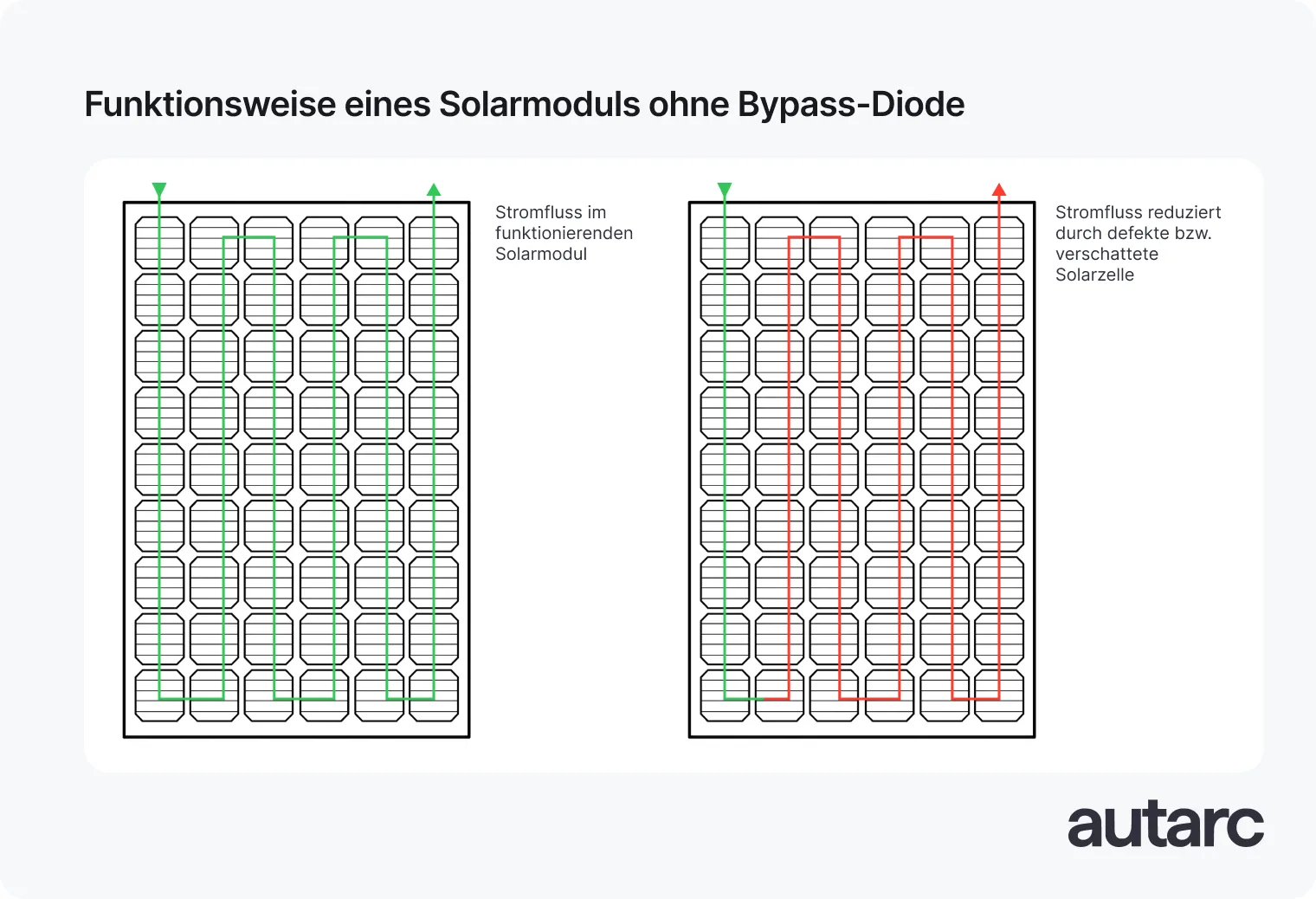
Without bypass diodes, any shading would immediately affect the performance of the entire solar module, as all cells are connected in series. Even a single shaded element can reduce the current flow for the entire string. Bypass diodes minimize this effect and ensure that shaded or defective cell groups do not reduce the yield of the entire photovoltaic system. In this way, they ensure efficiency, yield and operational safety in the long term.
How do bypass diodes work?
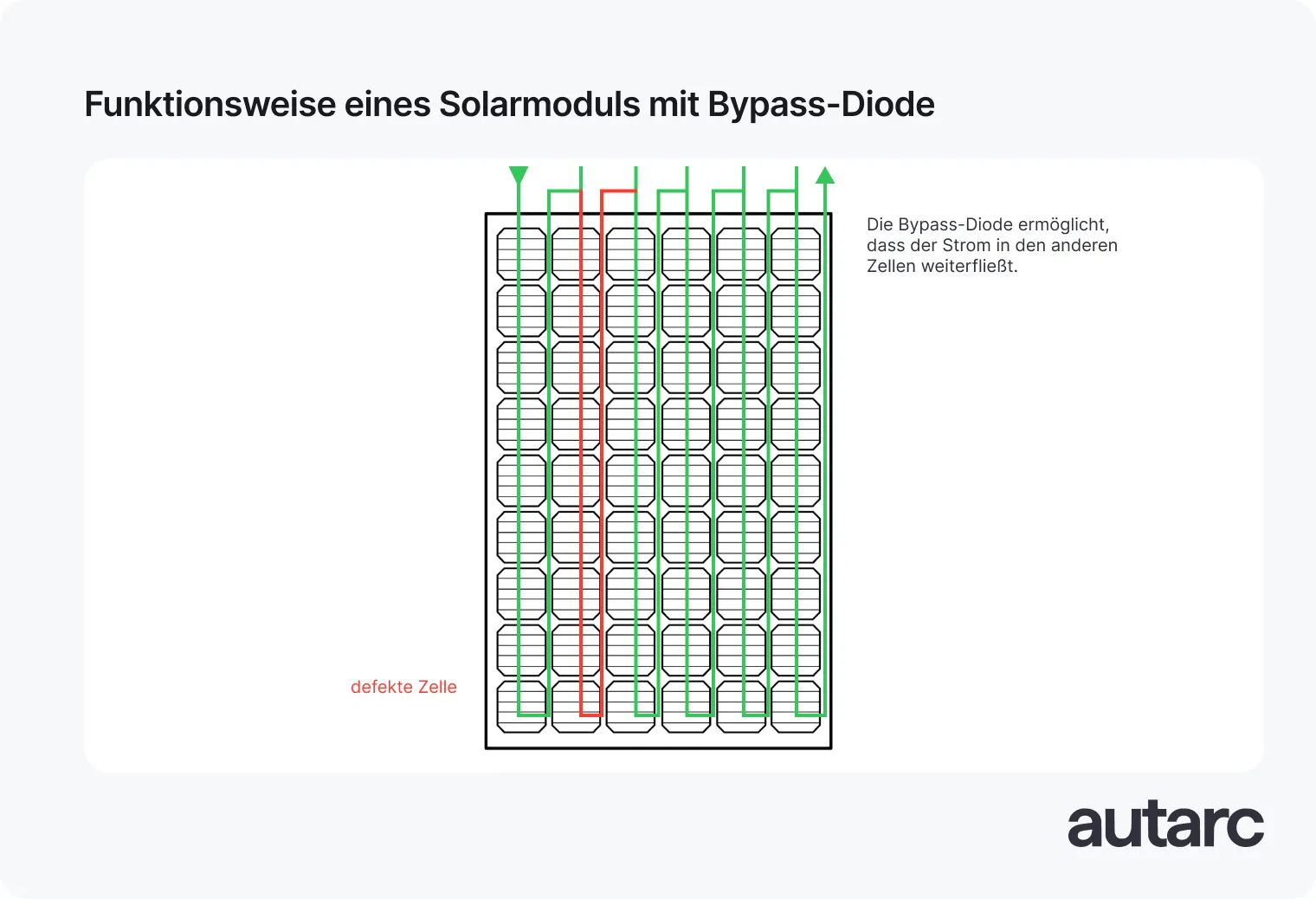
In the event of partial shading or a cell fault, bypass diodes conduct the current past the affected cell groups. They are connected antiparallel to cell strings and become conductive as soon as the current is blocked by the shaded cells. In this way, they prevent the flow of electricity throughout the module from interrupting or building up heat, which can cause so-called hotspots. In this way, the performance of the module is largely retained.
Bypass diodes: Why they are important for solar modules
Solar modules are particularly sensitive to shading. Even a small shadow can significantly reduce the yield of a solar system. But an inconspicuous component inside the modules protects against exactly this problem. Find out everything you need to know about bypass diodes here.
An overview of the most important things
- In the event of shading or defects, bypass diodes conduct the current past individual groups of cells.
- Without bypass diodes, even a small amount of shading can reduce the performance of the entire module.
- As a rule, three diodes are installed per module, the number of which depends on the cell structure.
- Defective diodes lead to hot spots, loss of yield or even a risk of fire.
- The diodes are firmly integrated in the junction box and cannot be replaced.
- When planning, pay attention to the number of diodes and quality features such as junction boxes and data sheet specifications.
What is a bypass diode?
A bypass diode is a protective diode in a solar module that transmits current past affected cell groups in the event of partial shading or cell defect. It prevents loss of performance and protects cells from overheating due to so-called hotspots. Without bypass diodes, the current flow in the entire module would be disturbed, which could significantly reduce the output of the photovoltaic system.
Why are bypass diodes important?
Bypass diodes bridge individual cell groups in the event of partial shading or defects and thus maintain the flow of current in the solar module. As a result, they prevent performance losses and protect solar cells from overheating and damage caused by hotspots. Without bypass diodes, even a small amount of shading can significantly reduce the yield of the entire module.
How many bypass diodes does a solar module have?
A standard solar module usually has three bypass diodes. Each diode protects a cell group, usually consisting of 20 cells in 60-cell modules. Larger modules with 72 or 144 half-cells can contain correspondingly more diodes. The exact number depends on the module structure and influences how well the module continues to supply power when partially shaded.
Where are bypass diodes located in the PV module?
Bypass diodes are integrated as standard in all solar modules and are located in the junction box on the back of the PV module. There, they are connected directly to the cell groups and divert power when shaded. Depending on the type of module, there are usually two to three diodes in the junction box, each of which protects a defined number of solar cells. The exact number is specified in the manufacturer's data sheet.
What happens if a bypass diode fails?
If a bypass diode fails, the current can no longer be diverted when shaded. This leads to yield losses, increased cell resistance and strong heat generation in the affected area. As a result, hotspots can arise which permanently damage the module or, in the worst case, trigger a fire. A failure often goes unnoticed, but affects the safety and efficiency of the entire photovoltaic system.
How do I recognize a defective or overloaded bypass diode?
You can recognize a defective or overloaded bypass diode by sudden power losses, unusual temperature differences in the module (e.g. due to thermography) or error messages in the monitoring system. Visible damage to the junction box or a noticeable smell can also indicate a defect. In such cases, the PV system should be provided by a Specialist company checked become.
What are the risks without bypass diodes?
Without bypass diodes, a solar module is unprotected in the event of partial shading or cell defects, which can result in significant safety and performance losses. The most important risks are:
- Performance drop in the entire module: Since the solar cells are connected in series, a shaded cell has an effect on the current flow of the entire module.
- Hotspot formation: Shaded cells absorb electricity instead of delivering it, heat up strongly and can be damaged.
- Module overheating and fire risk: Overheated cells increase the risk of thermal damage and even pot burn.
- Faster module aging: Permanent thermal stress leads to material fatigue and shortens the lifespan.
- Failure of entire strings: Severe shading without bypass diodes can impair the function of not only the affected module but also an entire string.
Can bypass diodes be retrofitted?
As a rule, bypass diodes cannot be retrofitted as they are firmly integrated into the solar module junction box. Subsequent installation is technically complex and does not make economic sense. If bypass diodes are missing or defective, it is usually necessary to replace the entire module or junction box by a specialist company.
How do bypass diodes interact with MPPT and inverters?
Bypass diodes support the MPPT (Maximum Power Point Tracker)by keeping the current flow stable when partially shaded. As soon as individual cell groups are shaded, the diodes redirect the current so that the MPPT can still find an optimal operating point for the remaining module part. As a result, energy yield is improved even under adverse conditions and yield losses are minimized.
What should you pay attention to when buying and planning?
When buying and planning a photovoltaic system, bypass diodes should be considered carefully, as they are decisive for the protection and performance of your modules. These points are particularly important:
- Check the number of bypass diodes: The more cell groups are protected by individual diodes, the lower the loss of power when shaded. Make sure that the module has at least 2 to 3 diodes.
- Identify shading risks on the roof: Chimneys, dormers or trees can regularly shade individual module areas. In such cases, a good division of cell groups and functioning bypass diodes are particularly important.
- Read the module data sheet carefully: The data sheet should contain clear information on the number and type of bypass diodes. If these are missing, this may indicate inferior module technology.
- Pay attention to the quality of the junction box: The bypass diodes are installed in the junction box. It should be well-made, weatherproof and heat-resistant to avoid defects.
- Monitoring and maintenance enable: Rely on a system that can detect performance drops. This allows diode defects to be identified and repaired at an early stage.
- Ask the installer specifically: Clarify with the specialist company how shading is taken into account, how many bypass diodes the selected modules contain and whether they can be replaced in the event of a failure.
Conclusion: When do bypass diodes make sense?
Bypass diodes are always useful when individual module areas can be temporarily shaded. They protect the modules from hotspots and ensure the flow of electricity despite partial shading. As a result, they make a significant contribution to the longevity and yield stability of the plant. Homeowners should therefore pay particular attention to well-equipped modules with integrated bypass diodes and take shading into account as early as the planning stage.
The new standard for installers and energy consultants
Are you installing heating systems, PV systems, battery storage systems or wallboxes? With autarc, you can carry out acquisition, planning, promotion, maintenance and customer communication in one software. Digitize your processes and make your company fit for the future. Try it now for free for 14 days!